Airline Reservation System Training
I helped roll out training for One Res, Southwest Airlines' new reservation system, in 2017. With a team of designers, I built training that taught call center agents, gate agents, and supervisors to use every part of the system. I also owned something no one else did. I built the training for visually impaired call center agents in Atlanta, who needed a completely different set of materials to succeed.
Role
Senior Instructional Designer
Ownership
One Res training with the team, plus sole owner of accessible training
Partners
Amadeus IT SMEs · Southwest leadership
Audience
Call center agents, gate agents, supervisors
The stakes
In May 2017 Southwest replaced a 30-year-old patchwork of legacy systems with One Res, built on the Amadeus Altéa platform. It was one of the biggest IT migrations in aviation. Southwest put over $500 million and years of work into moving more than 100 million annual passengers and 20,000 employees onto the new system.
The training risk was front and center. More than 20,000 frontline employees had to change how they did their jobs overnight. Any gap in knowledge would bottleneck check-ins and gate turns the moment the system went live. Other airlines had lived through migrations that crashed and made headlines.
For Southwest, a botched rollout during peak season meant lost sales and lasting damage to its reputation. For travelers, it meant the difference between a smooth trip and hours at the gate with a handwritten boarding pass. A group of call center agents in Atlanta were visually impaired, and standard training didn't work for them. Their success counted as much as anyone's.
The approach
I started where good training has to start, with the learner. For the visually impaired agents, that meant flying to Atlanta to meet them in person and ask the right questions before I designed anything.
Met the learners first
Flew to Atlanta and sat with the agents to understand how they work. Service dogs, screen-reader software, break times, and room to move with a walking stick all shaped the plan.
Designed for how they actually learn
Built materials that JAWS could read aloud and that worked across different kinds of visual impairment, with ADA accommodations in from the start.
Kept it aligned to the rollout
Delivered on the same timeline as everyone else, so these agents went live on One Res with their peers instead of behind them.
The solution
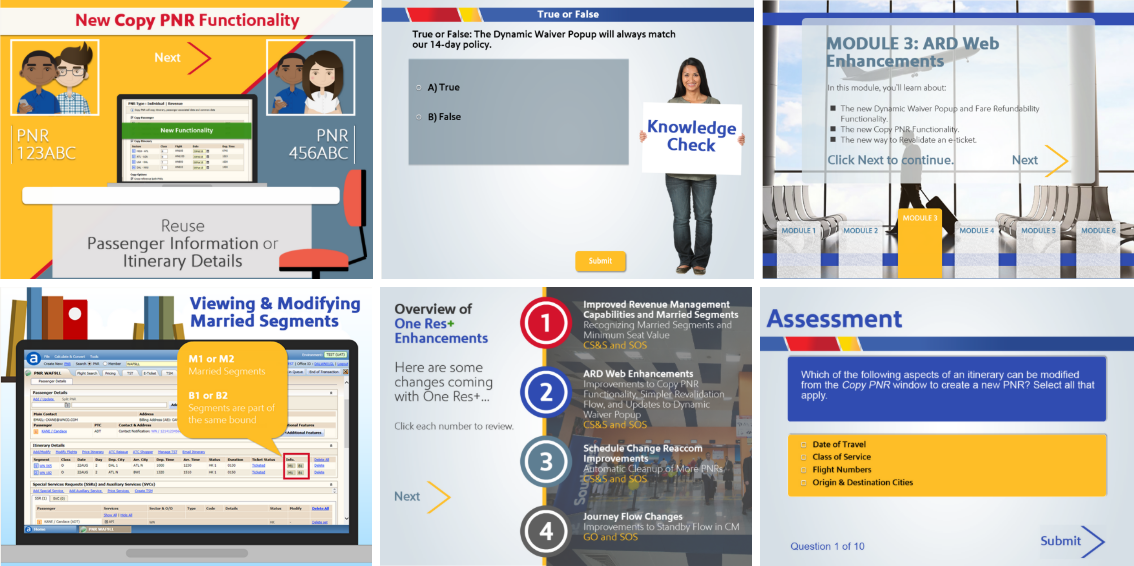
With the design team, I helped build the full One Res curriculum for call center agents, gate agents, and supervisors. On the accessibility side, I delivered materials that screen readers like JAWS could read, formats that worked for different visual impairments, and an ADA-compliant classroom setup. Every agent could learn the system no matter how they take in information.
Built with Captivate · JAWS screen-reader support
How I measured success
Success meant agents could do the job on the new system, and the numbers backed it up.
80%
System adoption
85%
Time-to-competency
Met
Handle-time requirements
What it set in motion
The accessibility work wasn't a one-off fix. It set a pattern for building training that every agent can use, so future rollouts could start from the same expectation instead of treating access as an afterthought.
Want the full walkthrough or the source files?
© 2026 Tonya Weathers · L&D Leadership Portfolio